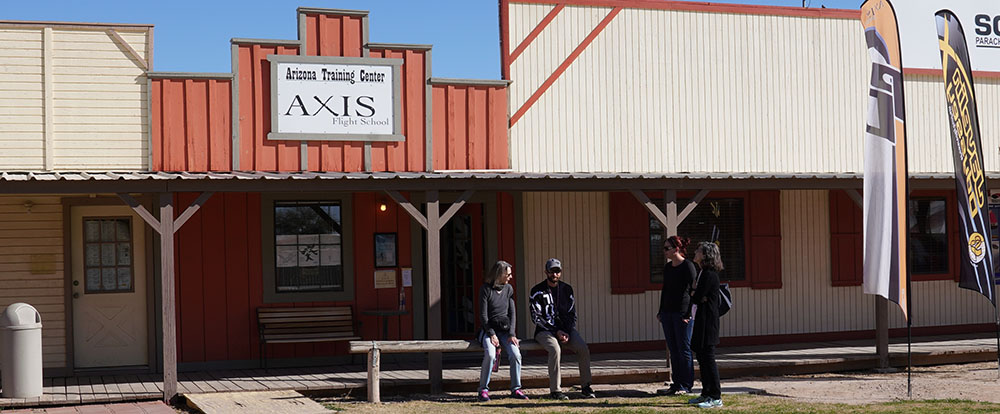
The AXIS Flight School Curriculum


Body Flight


BF.1 Mission statement

To create superior body-pilots by increasing the student’s physical awareness and understanding of efficient body mechanics and aerodynamics.

BF.2 What is body-flight (body-pilot)?

A body-pilot is someone who has the ability to fly his or her body with absolute control and intent, through the vertical airflow that is produced in freefall. Skydivers are most commonly seen flying with their bellies towards earth. Through added awareness of aerodynamics and body mechanics, a body-pilot is capable of maneuvering through the air on his or her belly, as well as their back, feet, and head. When these four basic neutral positions of flight are learned, and the transitions between them understood, a new dimensions of flight is unveiled that allows the flyer to explore a seemingly endless amount of possibilities. We believe that it is crucial that one should not limit themselves in their practice of flight by adhering to labels such as “freeflying” or “formation flying”. Take an interest in all flight, and you will notice that they all compliment each other.

BF.3 What to expect

We offer courses ranging from basic, such as first timers and AFF students, to experienced skydivers and tunnel flyers.

BF.3.1 Wind Tunnel Training

All tunnel-coaching sessions are preceded with a thorough 30-minute brief on body positions and maneuvers being practiced, followed by your flight time. Your flight time will be broke up into approximately two-minute increments, allowing you to take breaks in between flights. Once your time is over, a thorough de-brief with video analysis will end the session.

  • Tunnel orientation and safety brief (if applicable)
  • Communication in the tunnel (hand signals)
  • Learning proper body position and drives
  • Flying in the tunnel with your coach
  • Quick chat during your breaks
  • Thorough video de-brief
  • Assessing goals and creating a personalized program

BF.3.2 Sky Training

After you have learned the basics in the tunnel, take your new knowledge to the sky where you will be able to explore new challenges, such as exit techniques and utilizing greater spaces and speeds that the sky has to offer. All jumps will be pre-briefed, recorded and reviewed after landing.

  • Drop zone orientation (if applicable)
  • Equipment and safety brief
  • Communication in the sky (hand signals)
  • Proper body positioning
  • Exploring exit techniques and presentation for groups and individuals
  • Tracking (belly and back)
  • Break off procedures
  • Altitude awareness
  • Parachute deployment
  • Malfunction recognition and proper action
  • Basic canopy skills and safety
  • Assessing goals and creating a personalized program

It is important to have a solid foundation of the skill and knowledge of your current level of competency before attempting to learn something new. In order to find out what your individual needs are, we utilize a flight progression to outline my coaching programs. Even though this progression has proven to be effective for many years, it is not set in stone and is adjustable to maximize your learning experience.

To get a small preview of a coaching session, please check out my instructional videos.

BF.4 Flight Progression

To become a body-pilot one must attain understanding and physical awareness of body-aerodynamics. Having a flight progression creates just that. Learning a set of basic skills, which can be built upon, is key to a productive learning environment.
With Freeflying becoming more popular due to wind-tunnels and more understanding of body-aerodynamics, many skydivers rush immediately to sit-fly and head-down right after they graduate AFF. This causes them to miss out on a lot of important basics such as belly and back flying, which is vital for any body-pilot. Almost all freefly transitions pass through the belly and back-fly positions. With so many jumpers neglecting this fact, they will have to re-learn basic principals to progress any further with their body-flight skills.
Once the four neutral positions (belly, back, sit, head down) have been cultivated, one can fly through all dimensional axis of the body. Upon further refinement it is possible to fly around other axis’s unseen, such as around other flyers.

BF.4.1 Basic Belly (FS)

Flying on your belly is the most basic and important position to learn. You don’t have to join a FS team, but possessing the skills necessary to be on one can’t hurt.

  • Body position
  • Proper exit techniques
  • Fall rate control
  • Horizontal movement (forwards, backwards and sideways)
  • Turning
  • Docking (grips)
  • Super positional moves (2 directions at once)
  • Tracking
  • 2-way, 3-way, 4-way
  • Formations from the IPC dive-pool (Blocks and Randoms)
  • Leg turns (flying with booties)

The advantages of being a good belly flyer are that you become familiar with basic skills that will carry over to other positions. You do not have to become a FS competitor to advance to the next level in the progression, however, the more knowledge you have the better.

BF.4.2 Tracking

Article «Tracking - Theory and Application» by Niklas Daniel and Brianne Thompson. Photos by Niklas Daniel.
Published in Parachutist iss. 611, Sep. 2010, pg. 44 – 47.

Click here to read our article.

BF.4.3 Back-fly

Back-flying is the first big step towards Freeflying. This position offers a new set of challenges and needs to be learned well before moving on to sit-fly. In fact, back and sit-fly are very similar in some of the movements that it doesn’t hurt to spend some extra time on it.

Back-fly progression:

  • Body position
  • Proper exit techniques
  • Fall rate control
  • Horizontal movement (forwards, backwards and sideways)
  • Turning (using upper and lower body)
  • Transitions (Barrel rolls 180’s, and 360’s)
  • Docking (grips)
  • Super positional moves (2 directions at once)
  • Tracking

The advantage of back-fly is that it offers a huge range of fall rate. It is possible to fly with belly flyers, as well as people that are on their heads. This makes this position a great “safety position”. If you ever find yourself becoming unstable while freeflying, go to your back! It will allow you to maintain a fast fall rate and prevent you from colliding with other jumpers.

BF.4.4 Back Tracking

Back tracking is another important basic to become proficient at. When traveling at higher speeds, such as sit-fly and head down, it is key to have a smooth transition to your track. Going immediately from a sit to a belly track is not a good idea when flying with others. Use the wide range in fall rate that back-fly offers and transition to a back-track. Once you have gained some separation between the flyers in your group, it is ok to then transition to your belly.

  • Back tracking exit
  • Heading control
  • Fall rate control
  • Speed control
  • Break off procedures (different on tracking dives)
  • Transitions (back to belly/belly to back)
  • Docking

An added benefit that back-tracking offers is that you gain more awareness of your surroundings, especially being able to look above at pull-time.

BF.4.5 Sit Flying

If you have established a solid back-fly foundation, sit-fly is the next position in the progression. In my opinion this is the most difficult body position to get truly good at. Because of its awkward aerodynamics (both legs pointed down) and counter intuitive movements.

  • Body position
  • Correct exit technique
  • Heading control
  • Fall rate control
  • Horizontal movement (forwards, backwards and sideways)
  • Turns (upper and lower body)
  • Transitions (cartwheels, front loops, back loops)
  • Docks
  • Break off procedures

Sit-fly is a vertical flying position, which brings along with it higher wind speeds, power, and a smaller margin for error. Keep your movements small and study their effects. Go to your back if you become unstable!

Article «Thinking on Your Feet - Improving Your Sit-Fly » by Niklas Daniel. Photos by Brianne Thompson.
Published in Parachutist iss. 615, Jan. 2011, pg. 48 – 51.

Click here to read our article (note: download size is 12 MB).

BF.4.6 Head Down

Becoming proficient at Head-down will open a huge range in your body-flight. Your transitions will become smoother and more precise. This body position, just like sit-fly has high air speeds, and must be learned well before jumping with others.

  • Body position
  • Correct exit technique
  • Heading control
  • Fall rate control
  • Turns
  • Horizontal movement (forwards, backwards and sideways)
  • Transitions (front loop, back loop, cartwheel)
  • Docks
  • Correct break off procedures

When practicing head-down make sure that you are facing perpendicular to the line of flight due to the vast distances this position can cover in a short time.


Canopy Flight


CF.1 Mission statement

To create canopy pilots that can make educated decisions and to deepen the students understanding of technical knowledge and application in any condition.

CF.2 Canopy Courses

CF.2.1 Basic Canopy Course

Course consisting of: 6 hop and pops

- Intro to AZDZ and Safety Rules
- Assessment of current skill level and goals

Inventory and Gear Check:

  • Canopies (Main and Reserve – in date?)
  • Rig (how to put it on properly)
  • Risers and toggles (riser length can influence breaks)
  • Links (soft vs. hard)
  • Altimeter (Analog or Digital)
  • Collapsible slider (how to and purpose)
  • Suit vs. Street Clothes (emergency procedures on opening)
  • Helmet (open vs. full face)
  • Eye protection (distortion?)

Introduction to canopy:

  • 9-cell vs. 7-cell
  • Aspect ratio
  • Wing Shape
  • Line Trim

How to control the canopy:

  • Controls: Breaks, Rears, Fronts, Harness
  • Aviation vocabulary: Yaw, pitch, and Roll

Performance Oriented goals:

  • Landing Patterns (Flight paths and altitudes)
  • Navigating through traffic (collision avoidance)
  • Accuracy trick (visual cues)
  • Making it back from long spots (Minimum sink vs. Maximum glide)
  • Negative Turns
  • Stand up landings (arm position in full shut down vs. running)
  • Understanding Ground vs. Airspeed
  • Recognizing and reading WIs (Flags, Windsocks, tetrahedrons, wind blades, streamers, etc.)
  • Locating the holding area (no “vulturing”)

Safety Review:

  • Rear Riser control on opening
  • Canopy collision avoidance (turn right)
  • Canopy Check and Landing Priorities
  • Malfunctions and Decision Altitudes
  • Pull altitude and exit order
  • Review function and application of RSL / Skyhook (when to disconnect)
  • Emergency Landings on buildings, power lines, trees, and in water
  • Rotors and Dust Devils (recognition and avoidance)
  • Landing off
  • PLF (how to fall correctly)
  • Gaining control of canopy after landing (Re-inflation)

CF.2.2 Advanced Canopy Course

Course consisting of: 4 hop and pops and 2 HAHO's

- Intro to AZDZ and Safety Rules
- Assessment of current skill level and goals

Inventory and Gear Check:

  • Canopies (Main and Reserve – in date?)
  • Rig (how to put it on properly)
  • Risers and toggles (riser length can influence breaks)
  • Links (soft vs. hard)
  • Altimeter (Analog or Digital)
  • Collapsible slider (how to and purpose)
  • Suit vs. Street Clothes (emergency procedures on opening)
  • Helmet (open vs. full face)
  • Eye protection (distortion?)

Introduction to:

  • Cross and down wind landings
  • Kiting and relevancy to landing (speed flying)
  • Wing-loading (application for down-sizing and CRW) field elevation
  • Exit strategies for 2-ways (HAHO’s)
  • Getting together
  • Flying on a 3-D grid
  • Canopy burbles
  • Emergency Procedures for collisions
  • Landing out / reading terrain for landing

Performance Oriented goals:

  • Landing Patterns (stair stepping)
  • Crabbing (true, holding, running)
  • Low Speed Stalls and Recover (line slack)
  • 2-way relative work (no contact)

CF.3 Swoop Courses

CF.3.1 Swoop Level 1 Course

Course consisting of: 6 hop and pops

- Intro to AZDZ and Safety Rules
- Assessment of current skill level and goals

Inventory and Gear Check:

  • Canopies (Main and Reserve – in date?)
  • Rig (how to put it on properly)
  • Risers and toggles (riser length can influence breaks)
  • Slinks
  • Altimeter Digital
  • Collapsible slider / RDS is applicable
  • Helmet (open vs. full face)
  • Eye protection (distortion?)

Introduction to:

  • Aborting a low turn (get the nose up)
  • Pendulum effect
  • Riser turn vs. toggle turn
  • How to properly use dive loops (grip and timing)
  • Break Line length (relationship between break lines and trim when applying front risers)
  • Locating point of Initiation
  • Explanation of X-bracing
  • Packing and utilizing a RDS

Performance Oriented goals:

  • Double front riser approaches
  • 45degree front riser approaches
  • 90degree front riser approaches

CF.3.2 Swoop Level 2 Course

Course consisting of: 4 hop and pops and 2 HAHO's

- Intro to AZDZ and Safety Rules
- Assessment of current skill level and goals

Inventory and Gear Check:

  • Canopies (Main and Reserve – in date?)
  • Rig
  • Risers and toggles
  • Slinks
  • Altimeter - Digital
  • Collapsible slider / RDS
  • Helmet (open vs. full face)
  • Eye protection (distortion?)

Introduction to:

  • High Speed Stalls and Recovery
  • Opening of Chest Strap
  • Minimizing Drag (Lines, Slider, Suits, RDS, Risers, etc.)
  • Dragging a foot across the ground / water
  • Flying through gates
  • Competition Courses and Rules
  • Course Strategies
  • How to get out of the pond
  • Wet gear? (Rig, Canopies, AAD, full face helmets)

 
Performance Oriented goals:

  • High Performance turns at Full Altitude
  • Transferring to Rear Risers on landing
  • Flying though 10 foot gates